







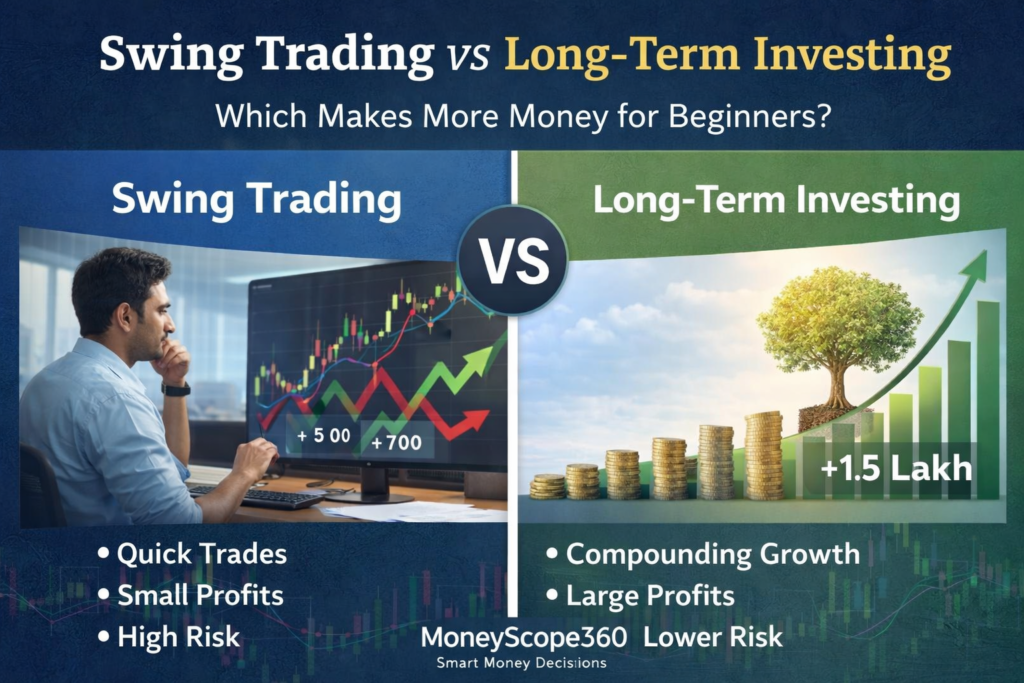
Swing Trading vs Long-Term Investing: Which Makes More Money for Beginners?
The Real Starting Point of Every Beginner
You start with a small amount of money and a simple goal — to grow it faster.
Very quickly, you come across two popular approaches. One promises quick profits through swing trading. The other focuses on steady wealth creation through long-term investing.
Both sound right. Both seem logical.
But choosing the wrong approach in the beginning can cost you time, money, and confidence.
When considering investment strategies, many beginners often wonder about the differences between Swing Trading vs Long-Term Investing.
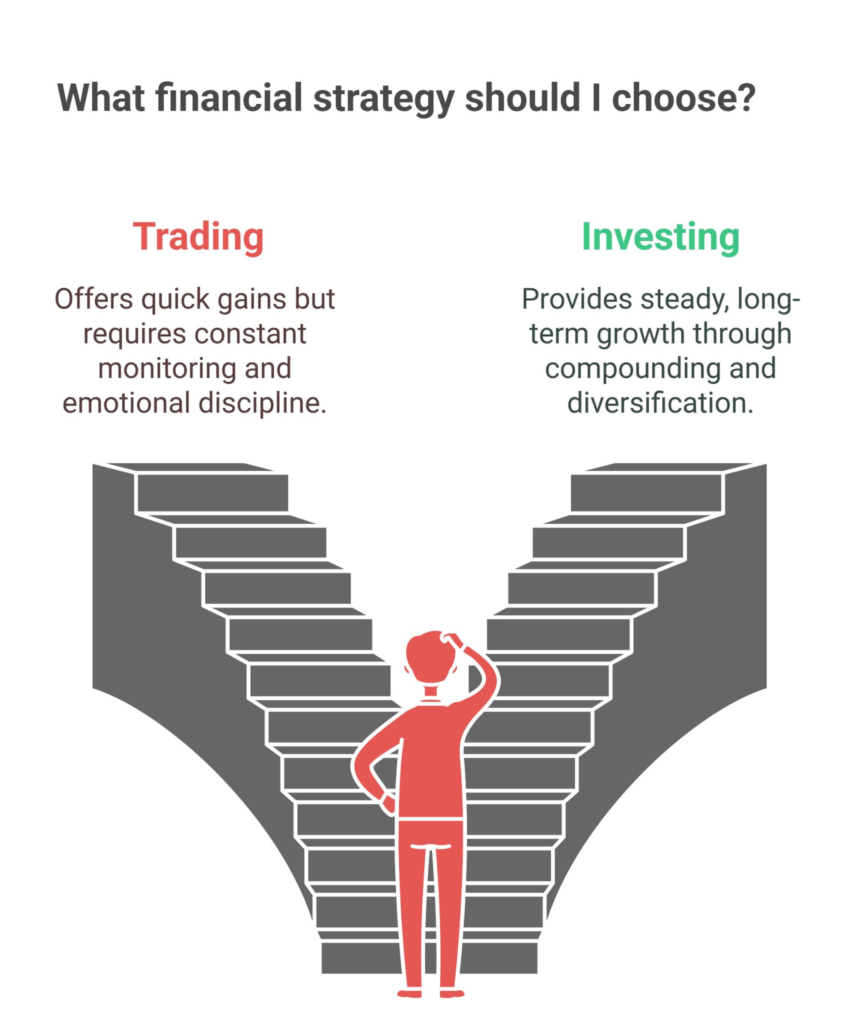
This is especially true for middle-class investors. They usually start with limited capital, such as 5,000 or 10,000. Because of this, long-term investing feels slow and less attractive in the beginning.
Naturally, they look for faster ways to increase their capital. This is where swing trading or short-term trading comes into the picture.
The thought process is simple and logical:
This leads to the essential comparison of Swing Trading vs Long-Term Investing, which every beginner should understand.
If I can generate profits through swing trading, I can reinvest those profits into long-term investments and build wealth faster.
On the surface, this looks like a smart and practical approach.
However, the real challenge begins when this idea is executed without proper understanding.
Many beginners also make early financial mistakes before even understanding investing. You can read more in Common Money Mistakes Indians Make in Their 20s (And How to Avoid Them).
The Beginner Trap in Swing Trading
The biggest mistake beginners make is entering trading without experience.
They watch videos, follow influencers, and learn basic concepts like support, resistance, and breakouts. After a few successful trades, confidence increases quickly.
At this stage, many beginners feel they have understood the market.
They start doing swing trading using:
- Technical indicators
- Chart patterns
- Momentum-based entries
But there is a major gap in their approach.
They rely only on technical analysis and completely ignore the fundamentals of the company.
This creates a weak foundation for decision-making.
The Missing Piece: Fundamentals
Technical analysis helps you understand price movement. But it does not tell you the strength of the business.
Fundamental analysis helps you understand:
- Whether the company is financially strong
- Whether it has future growth potential
- Whether it can recover from temporary declines
When beginners ignore fundamentals, they are essentially trading without knowing what they are holding.
This becomes dangerous when the trade does not go as expected.
Understanding fundamentals is important because it tells you whether a company is strong or not. For a basic explanation of how fundamental analysis works, you can refer to Investopedia.
What Happens When Things Go Wrong
Every trader faces losing trades. That is part of the market.
But the difference lies in how you handle those situations.
If you enter a trade based only on charts or momentum, and the price starts falling, you are left confused.
At that point, you have two choices:
- Exit early and take a small loss
- Hold the stock and hope it recovers
Most beginners choose to hold.
The reason is simple. They do not know whether the company is strong enough to recover.
This lack of clarity turns a small loss into a large loss.
In many cases, capital gets stuck for months or even lost completely.
The Emotional Side of Trading
Trading is not just technical. It is psychological.
When a trade goes wrong:
- Fear increases
- Decision-making becomes weak
- Discipline breaks
Beginners often ignore stop-loss rules because they hope the price will reverse.
This emotional decision-making is one of the biggest reasons for losses.
Without experience and discipline, trading becomes stressful and inconsistent.
My Personal Learning About Swing Trading
From my personal experience, swing trading should not be done randomly.
It should be done only on fundamentally strong stocks.
A stock that you have observed over time.
A stock whose price behavior you understand.
A stock that your mind is comfortable tracking.
When you continuously observe a stock, your brain starts recognizing its movement patterns.
You begin to understand how it reacts to market conditions.
At this point, when you combine:
- Fundamental strength
- Consistent observation
- Technical confirmation
Your decision-making improves significantly.
Swing trading then becomes a calculated move rather than guesswork.
Building conviction in stocks becomes easier when you understand strong businesses. A great example is From Fevicol to M-Seal: How a Brand Becomes the Product.
Long-Term Investing: The Stable Foundation
Long-term investing works on a completely different principle.
Here, you are not trying to predict short-term price movements.
Instead, you focus on:
- The company’s business model
- Its growth potential
- Industry trends
Even if the market fluctuates in the short term, strong companies tend to recover and grow over time.
This reduces pressure and allows compounding to work in your favor.
Long-term investing does not require constant monitoring. It requires patience and conviction.
If you are someone looking for safer and stable options before entering the stock market, understanding fixed income choices is important. Read FD vs RD vs Auto Sweep FD Explained: Which Is Best in 2026?.
Why Beginners Should Not Ignore Long-Term Investing
Many beginners think long-term investing is slow and less rewarding.
But this is a misunderstanding.
Long-term investing may appear slow initially, but over time it becomes powerful due to compounding.
It also provides stability, which is very important when you are starting your financial journey.
Ignoring long-term investing and focusing only on trading can increase risk significantly.
The Right Way to Combine Both Approaches
Instead of choosing one approach blindly, beginners should aim for balance.
Start with long-term investing to build a strong base.
At the same time, begin learning swing trading gradually.
Understand that swing trading is not a shortcut to wealth. It is a skill that takes time to develop.
Practical Strategy for Beginners
A simple and effective approach can be:
- Allocate a larger portion of your capital to long-term investments
- Use a smaller portion for swing trading
Before entering any swing trade:
- Check whether the company is fundamentally strong
- Observe its price behavior for a period of time
- Plan your entry and exit clearly
If the trade does not go as expected, exit early.
Do not hold blindly without understanding the business.
The Core Difference Between Trading and Investing
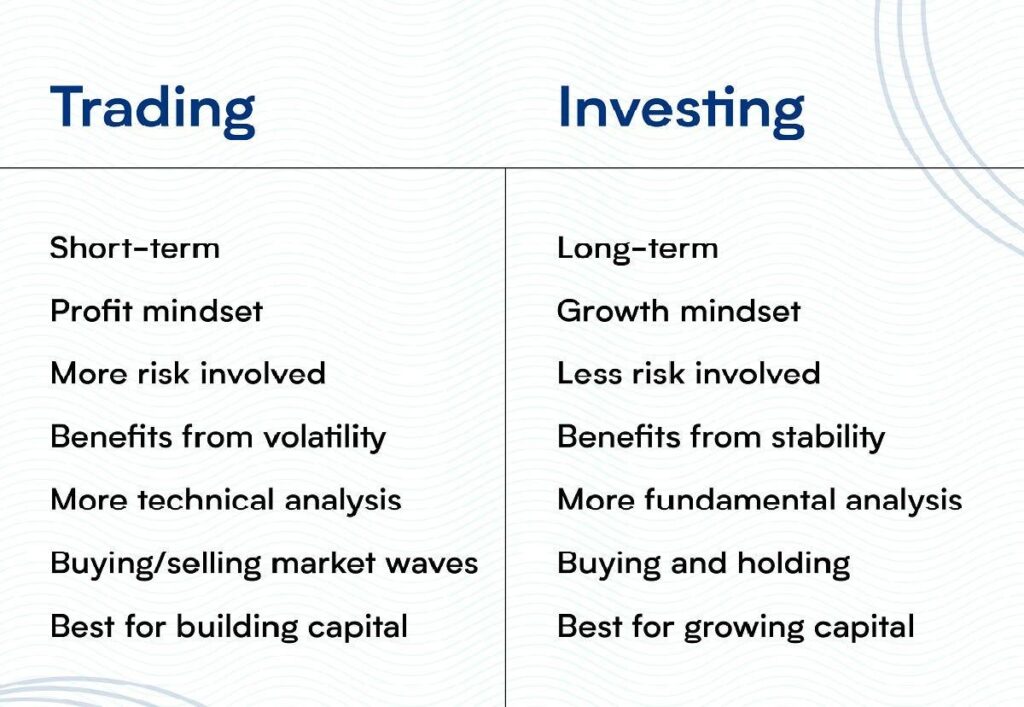
Trading is based on timing and short-term movements.
Investing is based on time and long-term growth.
Trading requires quick decisions and precision.
Investing requires patience and consistency.
Both have their place, but they serve different purposes.
Final Reality Check
Most beginners enter trading to grow money quickly.
But without proper knowledge and discipline, they end up losing money instead of growing it.
The smarter approach is to focus on learning first.
Start small, build experience, and gradually improve your strategy.
Do not depend only on technical analysis. Combine it with fundamental understanding.
Final Thoughts
In the end, choosing between swing trading vs long term investing depends on your knowledge, patience, and discipline.
The stock market rewards those who combine knowledge, patience, and discipline.
Swing trading can be effective, but only when done with proper understanding.
Long-term investing remains the most reliable path for building wealth over time.
One Line Takeaway
Do not use trading to escape small capital. Use knowledge and discipline to grow it step by step.
Written by Badri | MoneyScope360
360° of Money, Markets & Motivation



Post Comment