







CDSL The Silent Monopoly Behind India’s Retail Investing Boom
An asset-light growth story
For decades, stock market investing in India was considered complicated, risky, and meant only for experts. Demat accounts were rare, mutual funds were poorly understood, and equity participation was limited to a small section of society.
That perception has completely changed.
Today, India is witnessing a silent financial revolution, and at the heart of this transformation lies a company that operates quietly in the background but benefits from every new investor — Central Depository Services (India) Limited (CDSL).
India Has Only Two Depositories CDSL and NSDL
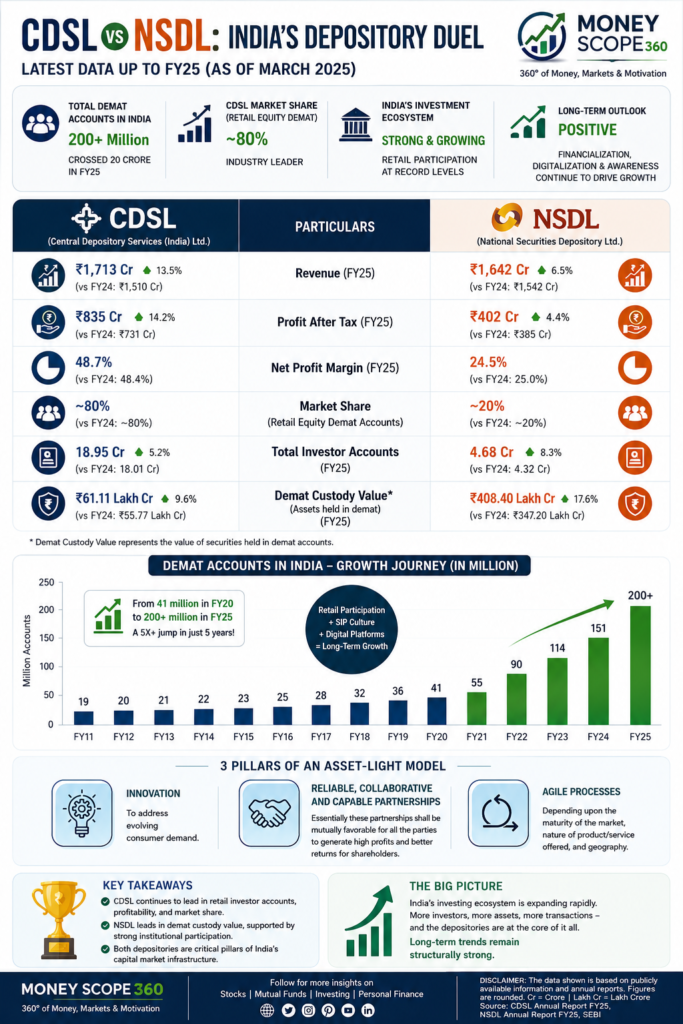
India’s securities ecosystem depends entirely on two depositories CDSL and NSDL. There is no third player.
This creates a strong entry barrier and gives the depository business an almost monopoly-like structure. In equity demat accounts, CDSL clearly dominates, especially among retail investors. Most discount brokers and digital investment platforms onboard clients primarily through CDSL.
This gives CDSL a structural advantage that strengthens as India’s investing population grows.
Another important point often missed is the network effect in this business. As more brokers, investors, and institutions connect to one depository, switching becomes difficult. This naturally strengthens the dominant player over time.
If you want to understand how financial awareness protects your money decisions, read this guide
https://moneyscope360.com/why-health-insurance-is-a-lifesaver-not-just-a-policy/
From an Unknown Concept to a Mainstream Habit
A decade ago, equity investing was seen as an unknown and risky activity. Savings were largely parked in fixed deposits, gold, or real estate. Mutual funds were misunderstood and often avoided.
Today, investing has become mainstream. SIPs are common, retail participation is at record levels, and mutual fund inflows remain strong. Stock market investing is no longer unfamiliar to Indian households.
Every new demat account and every market transaction benefits CDSL in some form.
The Retail Investor Shift Is Changing Everything
One of the biggest drivers behind this transformation is the rise of retail investors in India.
A new generation is moving away from traditional savings like fixed deposits and gradually shifting towards equities and mutual funds for long-term wealth creation.
Easy account opening, mobile investing apps, financial awareness, and social media education have made investing more accessible than ever before.
This is not a temporary trend. It is a structural shift.
Another important factor is demographics. India has a young population entering earning age, and this group is far more comfortable with digital platforms and market-linked investments compared to previous generations.
Every new retail investor entering the market strengthens CDSL’s ecosystem. As more people open demat accounts and participate in markets, CDSL continues to benefit directly from this growing financial participation.
CDSL’s Asset-Light Business Model


CDSL operates an efficient asset-light business. It does not require factories, heavy capital expenditure, or large inventories. Once its technology infrastructure is in place, incremental costs remain low.
This allows CDSL to generate high margins, strong cash flows, and consistent profitability. The company operates with zero debt and delivers healthy returns on equity, making it financially robust.
An additional advantage is operating leverage. As transaction volumes increase, a large portion of revenue converts directly into profit because costs do not rise at the same pace.
In simple terms
More investors lead to more transactions and more revenue without heavy cost increase
Why CDSL’s Performance Was Slightly Below Expectations Recently
Despite strong fundamentals, CDSL’s recent performance has been slightly below expectations. This has been largely due to global economic uncertainty and reduced market activity.
When global risk increases, foreign investors tend to sell, leading to lower transaction volumes. Since CDSL earns from market participation, short-term slowdowns in trading activity can impact revenue growth.
However, these challenges are cyclical and not structural in nature.
Global Uncertainty vs Retail Strength


Global concerns like trade wars, inflation, and geopolitical tensions may create short-term pressure, but they do not change the long-term direction of India’s investing culture.
What has changed is the mindset of Indian investors.
Unlike earlier cycles, retail investors today are not exiting markets completely during uncertainty. Many continue their SIPs and long-term investments.
This clearly shows a shift from fear-based investing to disciplined investing.
Another important trend is the rise of SIP culture. Monthly investments create consistent inflows into the market, reducing volatility impact and supporting transaction volumes.
The move from fixed deposits to equity markets is driven by a deeper understanding that inflation reduces FD returns while equity creates long-term wealth.
This evolving behavior acts as a strong cushion for CDSL even during periods of global volatility.
Mutual Fund Inflows Continue to Support the Business
One of the strongest positives for CDSL is that mutual fund inflows have remained stable despite global volatility.
Retail investors continue SIP investments, which helps support market volumes even during periods of foreign investor selling.
This indicates that India’s markets are becoming more domestically driven and less dependent on global capital.
Another emerging factor is the growth of systematic investing platforms and fintech companies, which are continuously onboarding new users and expanding market participation.
Risks and Negatives Investors Should Know
While CDSL has strong long-term fundamentals, it is important to understand the risks.
Revenue is closely linked to capital market activity. During prolonged market slowdowns, transaction volumes can decline.
Regulatory changes remain a key risk as the company operates under strict oversight.
Valuation risk exists because the stock often trades at a premium.
Competition from NSDL, though limited, still exists.
In addition, technological risks such as system failures or cyber threats, though rare, can impact trust in such infrastructure businesses.
These are not weaknesses but realities of a market-linked business.
Strong Advantage When Global Conditions Stabilize


When global uncertainty eases and market participation improves, CDSL is well positioned to benefit immediately.
Its asset-light model allows higher transaction volumes to directly improve profitability.
Rising demat accounts, financialization of savings, growing mutual fund participation, and digital onboarding remain strong long-term drivers.
Another powerful trend is the formalization of the economy, where more savings are moving from informal channels into regulated financial systems.
The continuous rise of retail investors will play a crucial role in this growth.
Why Long-Term Investors Continue to Track CDSL
CDSL does not depend on aggressive expansion or debt-driven growth.
Instead, it benefits from India’s transition from savers to investors.
It is also important to understand that CDSL is not a typical cyclical business. It is part of financial infrastructure, meaning its relevance increases as the market ecosystem expands.
While short-term earnings may fluctuate, the long-term structural story remains intact.
Final Thoughts
Markets move in cycles. Global uncertainty affects sentiment. Earnings may fluctuate in the short term.
But India’s investing awareness has crossed a point of no return.
The shift from fixed deposits to equities, driven by rising retail participation, is one of the biggest financial transformations in India today.
This shift is supported by technology, demographics, financial awareness, and changing risk appetite.
While global risks may create temporary slowdowns, the long-term story remains strong.
As more Indians participate in capital markets, the institution safeguarding those investments becomes increasingly important.
CDSL is not just a stock. It is a core part of India’s financial infrastructure.
Written by Badri | MoneyScope360
360° of Money, Markets & Motivation



Post Comment